
Nota Volt
Nota Volt is a virtual-analog synthesizer — the classic two-oscillator subtractive voice (in the vein of Ableton Analog). Two oscillators plus a noise source feed two multimode filters and two amplifiers, shaped by dedicated filter and amp envelopes, two LFOs, a vibrato, a modulation matrix and eight macros. It’s the go-to for basses, leads, pads and plucks.
Overview
Section titled “Overview”Per voice, the signal flows:
Osc 1 ┐ ┌─ Filter 1 ─ Amp 1 ─┐Osc 2 ┼─ route per source ──┤ ├─▶ outNoise ┘ └─ Filter 2 ─ Amp 2 ─┘ (Filter 1 can also feed Filter 2)Each source (Osc 1, Osc 2, Noise) is routed to Filter 1 or Filter 2. Cutoff is moved by the filter envelope, keytracking and an LFO; the amp envelope shapes level. On top of the fixed routing sits a full modulation matrix and eight macros.
Interface
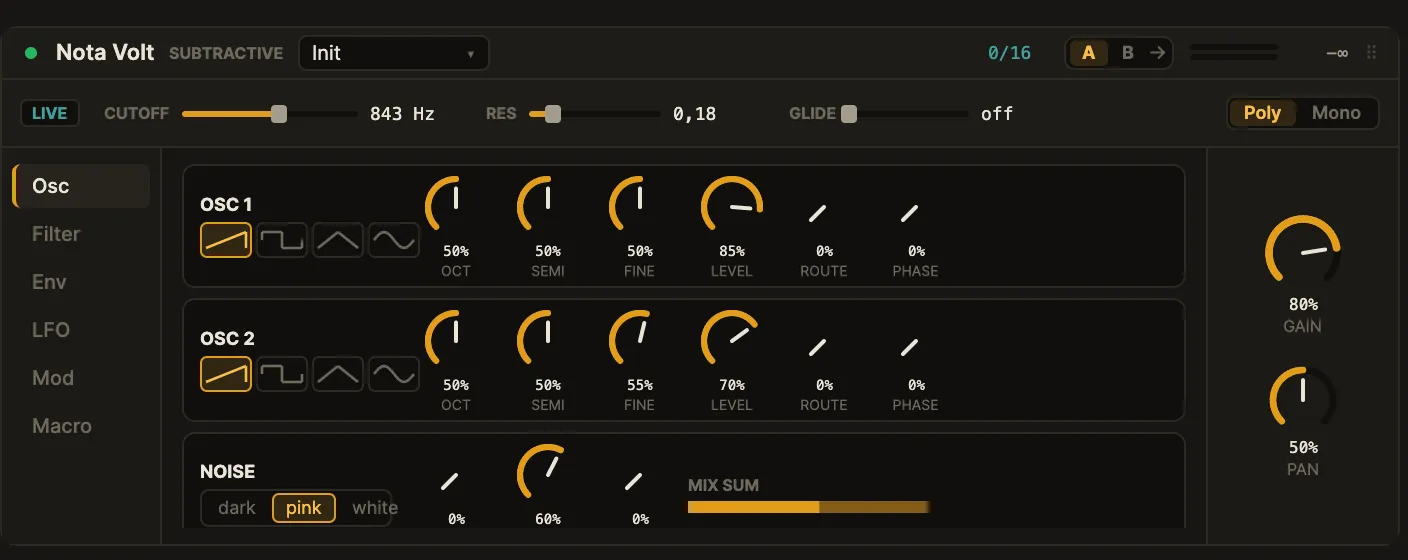
Section titled “Interface”The card (mockup 2e) is an always-visible live strip, a tab rail that swaps the body, and an output rail.
- Live strip —
CUTOFF,RESandGLIDEsliders plus the Poly / Mono voice mode, reachable from any tab. - Tab rail (left) — Osc · Filter · Env · LFO · Mod · Macro.
- Output rail (right) —
GAINandPAN; the header carries a live voice meter.
The tabs:
- Osc — three lanes: Osc 1 and Osc 2 (waveform, octave, semitone, fine, level, filter route, start phase) and Noise (level, colour, route) with a mix-sum meter.
- Filter — an interactive response graph with a Filter 1 / 2 selector; each filter has a type (LP · HP · BP · Notch), a 12 / 24 dB slope, cutoff, resonance, and envelope / key-tracking amounts.
- Env — the Amp (→ level) and Filter (→ cutoff) envelopes as interactive A/D/S/R graphs.
- LFO — LFO 1 and LFO 2 (shape, rate, depth, sync, fade) and a dedicated Vibrato.
- Mod — a 7×6 drag matrix of sources against destinations (drag a cell up for a positive amount, down for negative).
- Macro — eight macros, each a value with a destination and amount.
Parameters
Section titled “Parameters”Live strip:
| Parameter | Range | What it does |
|---|---|---|
Cutoff |
20 Hz…18 kHz |
Filter 1 cutoff frequency. |
Res |
0–1 |
Filter 1 resonance. |
Glide |
off…~2.4 s |
Portamento time between notes. |
Poly / Mono |
— | Polyphonic or monophonic voicing. |
Per oscillator (Osc 1, Osc 2):
| Parameter | Range | What it does |
|---|---|---|
Wave |
Saw · Square · Tri · Sine | Oscillator waveform. |
Oct / Semi / Fine |
— | Tuning by octave, semitone and cents. |
Level |
0–1 |
Oscillator level into its filter. |
Route |
Filter 1 / 2 | Which filter the oscillator feeds. |
Phase |
0–1 |
Start phase (0 = free-running). |
Noise: Level, Color (dark · pink · white), Route.
Per filter (Filter 1, Filter 2):
| Parameter | Range | What it does |
|---|---|---|
Type |
LP · HP · BP · Notch | Filter shape. |
Slope |
12 / 24 dB |
Filter steepness. |
Cutoff / Reso |
— | Cutoff frequency and resonance. |
Env / Key |
bipolar | Filter-envelope and keytracking amounts on cutoff. |
Envelopes, LFOs and modulation:
| Parameter | Range | What it does |
|---|---|---|
Amp env A/D/S/R |
— | Shapes each note’s level. |
Filter env A/D/S/R |
— | Moves the filter cutoff over time. |
LFO 1 / LFO 2 |
shape · rate · depth · sync · fade | Two modulators (sin · tri · sqr · S&H), optionally tempo-synced with per-note fade-in. |
Vibrato |
rate · depth | Dedicated pitch vibrato. |
| Mod matrix | 7 × 6, bipolar | Sources (Amp Env · Flt Env · LFO 1 · LFO 2 · Velocity · Key · Mod Wheel) to destinations (Pitch · Osc 2 · Cutoff · Reso · Level · Pan). |
| Macros 1–8 | value · dest · amount | Manual offsets into the same destinations. |
Gain / Pan |
— | Output level and pan. |
Tips & recipes
Section titled “Tips & recipes”- Fat detuned bass: two saws, set Osc 2’s
Fineslightly off Osc 1, add a littleGlideandMonofor slides. - Evolving pad: raise the filter envelope’s decay/sustain, assign LFO 1 → Cutoff
in the matrix, and add
Vibratofor movement. - Snappy pluck: short amp
Decay, lowSustain, and a filter envelope with fast decay so brightness drops quickly. - Playable macros: map a macro to
Cutoff(or several destinations at once) for a single performance knob.
See also
Section titled “See also”- Nota Operator — FM synthesis for metallic and bell tones.