
Nota Aurora
Nota Aurora is a wavetable synthesizer. Two wavetable oscillators (plus a sub) sweep through spectral tables that you scan and warp, then run into two filters, two envelopes, two LFOs, a modulation matrix, macros and a built-in drive · chorus · reverb block. It excels at evolving pads, digital basses and moving, animated timbres.
Overview
Section titled “Overview”Each voice runs two wavetable oscillators and a sub through the filters and amp:
Osc 1 ┐Osc 2 ┼─ route per source (F1 / F2 / Both / Dry) ─▶ Filter 1 · Filter 2 ─▶ amp ─▶ FX ─▶ outSub ┘ (parallel or series)An oscillator’s tone comes from a table (a stack of single-cycle waveforms) — the position scans through the frames, and the warp reshapes each frame. Envelopes, LFOs and the matrix animate position, cutoff and more.
Interface
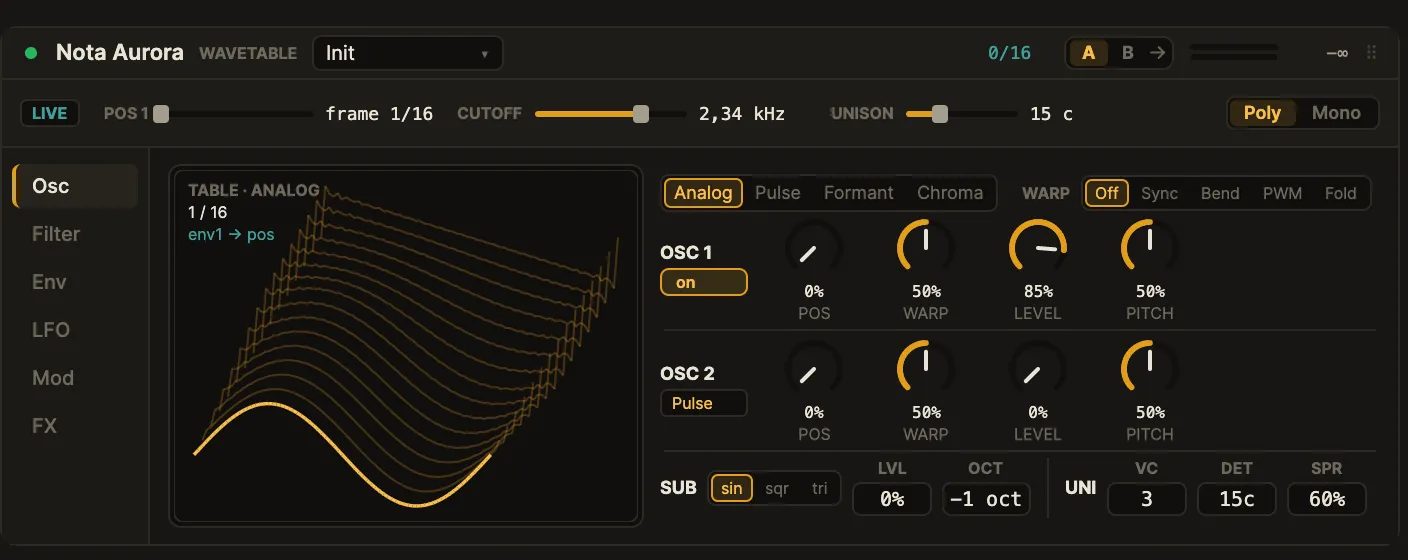
Section titled “Interface”The card (mockup 2j) is a live strip over a tab rail that swaps the body.
- Live strip —
POS(wavetable frame),CUTOFF,UNISONdetune, and Poly / Mono, reachable from any tab. - Tab rail (left) — Osc · Filter · Env · LFO · Mod · FX.
The tabs:
- Osc — a 3-D view of the current wavetable, the bank chips (Analog · Pulse · Formant · Chroma) and warp modes (Off · Sync · Bend · PWM · Fold), the two oscillators (position, warp, level, pitch), a Sub (wave, level, octave) and a Unison stack (voices, detune, spread).
- Filter — a Filter 1 / 2 selector with type (LP · HP · BP · Notch · Morph) and 12 / 24 dB slope; a response graph with freq / reso / env / LFO; and a Routing panel sending each source (Osc 1, Osc 2, Sub) to F1 / F2 / Both / Dry in Parallel or Series.
- Env — Env 1 (→ amp) and Env 2 (→ position / cutoff) as interactive A/D/S/R graphs.
- LFO — LFO 1 (shape, rate, depth, sync) and LFO 2 (shape, rate, depth).
- Mod — an 8×7 drag matrix plus four macros.
- FX — a built-in Drive, Chorus (amount + rate) and Reverb.
Parameters
Section titled “Parameters”Live strip:
| Parameter | Range | What it does |
|---|---|---|
Pos |
frame 1–16 |
Scans through the wavetable’s frames. |
Cutoff |
20 Hz…18 kHz |
Filter 1 cutoff. |
Unison |
0–50 c |
Unison detune spread. |
Poly / Mono |
— | Voice mode. |
Oscillators:
| Parameter | Range | What it does |
|---|---|---|
Bank |
Analog · Pulse · Formant · Chroma | The spectral table set. |
Warp mode |
Off · Sync · Bend · PWM · Fold | How the frame is reshaped. |
Position / Warp |
0–1 |
Scan through the table / warp amount. |
Level · Pitch (oct/semi/detune) |
— | Per-oscillator mix and tuning. |
Osc 1 On / Osc 2 |
— | Each oscillator has its own bank, position and warp. |
Sub |
wave · level · octave | Sine/square/triangle sub oscillator. |
Unison |
voices · detune · spread | Unison stack width. |
Filters, modulation and FX:
| Parameter | Range | What it does |
|---|---|---|
| Filter 1 / 2 | type · slope · freq · reso · env · LFO | Two SVFs; type includes a Morph. |
Routing |
F1 · F2 · Both · Dry | Where each source (Osc 1/2, Sub) goes, in Parallel or Series. |
Env 1 / Env 2 |
A/D/S/R | Amp envelope and a free envelope (→ position/cutoff). |
LFO 1 / LFO 2 |
shape · rate · depth · sync | Two modulators (sin · tri · sqr · S&H). |
| Mod matrix | 8 × 7 | Sources (Env 1/2 · LFO 1/2 · Velocity · Key · Mod Wheel · Random) to destinations (Pitch · Osc 2 · Position · Cutoff · Reso · Level · Pan). |
| Macros 1–4 | value · dest · amount | Manual offsets into the destinations. |
| FX | Drive · Chorus (+ rate) · Reverb | Built-in output effects. |
Tips & recipes
Section titled “Tips & recipes”- Evolving pad: assign Env 2 → Position (or LFO 1 → Position) in the matrix so the timbre morphs as the note sustains.
- Wide digital bass: raise
Unisonvoices and detune, keep itMono, and route both oscillators through Filter 1 in Series with Filter 2. - Vowel textures: pick the Formant bank and sweep
Positionwith an LFO. - Instant polish: add a touch of Chorus and Reverb on the FX tab.
See also
Section titled “See also”- Nota Volt — analog-style subtractive synthesis.
- Nota Operator — FM synthesis.